Artist Statement
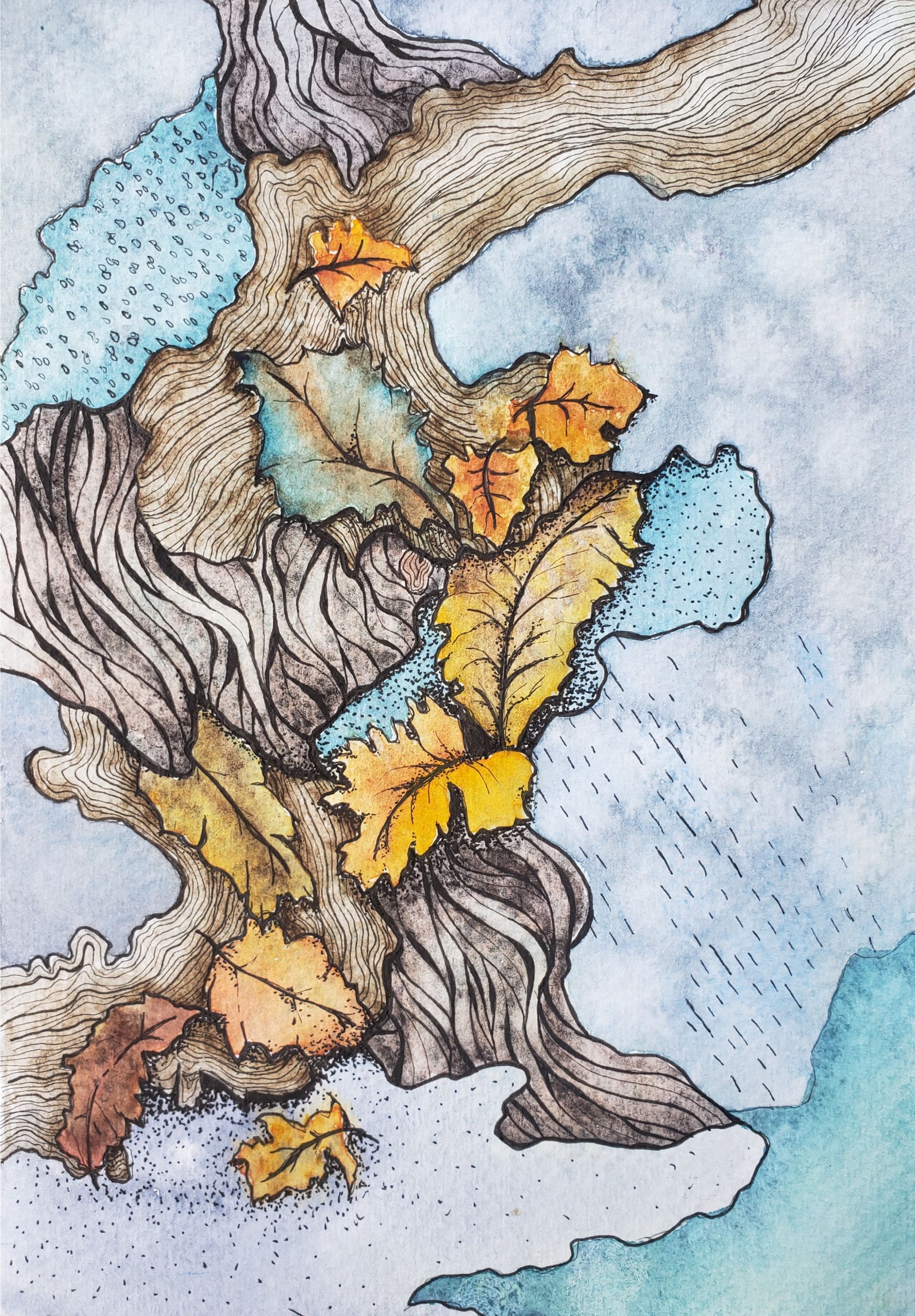
I make work about what it feels like to be a living thing among other living things. My subjects are drawn from the natural world — trees, roots, branches, the small architecture of growth and weather — but the drawings themselves are really about presence: the patience it takes to build something slowly, and the vulnerability of anything that has survived long enough to show its scars. I work primarily in dip pen, ink, and watercolor, though the underlying practice — attention, repetition, trust in the mark — was shaped by twenty years of working in fiber before I ever picked up a pen.
My work begins with a dip pen, an image that doesn't quite exist yet, and a question about where the natural world ends and something more human begins.
Across the work — whether it's a solitary ink study of a wind-bent trunk, or a girl caught mid-transformation into willow branches, or a quieter watercolor scene of stillness and light — I'm circling the same idea: that the natural world is never just scenery. It's a way of studying what is known and universal, and then exploring what is unique and mysterious in ourselves. Bark that peels back like it's shedding something. A figure whose hair becomes leaves. A slow-moving moment that asks to be noticed rather than rushed past. These aren't botanical illustrations or portraits so much as portals to emotion. Each piece is built slowly, through many small, deliberate marks, until the image emerges the way a feeling might: gradually, and then all at once.
I move between pure ink and ink-and-watercolor depending on what a piece needs. The ink-only work tends to be starker and more architectural — studies of structure, resilience, and quiet endurance. Bringing in watercolor opens the door to color, softness, and narrative — the fairy-tale register of a girl merging with a tree, or the warmth of an ordinary moment made a little enchanted. I don't think of one mode as more essential than the other; they're two ways of asking the same question about what connects us to the living world around us.
Ink, whether alone or with color, has become the medium that best matches how I think. It doesn't allow for much correction, but it lets me feel a form through the line itself — shadows and folds demanding more attention, more marks, more willingness to sit in the mystery of the darkness I'm creating. That patience traces back to twenty years spent working in fiber, where an unassuming wool fleece becomes a finished work only through washing, dyeing, spinning, and weaving — nothing rushed, nothing skipped. That discipline carried over when I began working in pen and watercolor, and it still shapes how I approach a page: in deliberate sessions, returning again and again to the same line or figure until it feels true rather than simply finished.
Underneath all of it are three things I keep returning to — awe at how strange and specific the natural world actually is up close, authenticity in drawing what something
feels like rather than what it photographs like, and purpose in making work built to be looked at slowly, the way it was made.